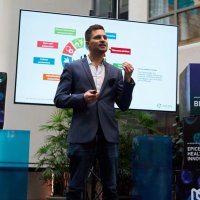
Linus Peters
Peters pushed longevity as a public-legitimacy problem: if aging is treated as inevitable, talent and money stay away. That is advocacy, not proof of field impact.
Role
populariserhigh confidence
The clearest longevity contribution here is field-building: he founded the Swedish Longevity Cluster and explicitly pushes longevity advocacy as necessary to change minds and mobilize resources. That is public-surface and movement infrastructure, not just commentary.
also: communicator
Dimension breakdown
This score rates longevity commitment only. The role tags above — scientist, investor, and the rest — say what this person is; we don't score those separately.
Evidence is still sparse for this hero. Scores are shown with low-confidence warnings until more source material is harvested.
Future vision
7.0/ 10
Linus Petersson has clearly and repeatedly articulated an ambitious public vision that aging should be stopped, death is bad, and indefinite lifespan extension through science is a worthy goal. He also gives a social-change theory of progress: science can solve aging if society chooses to invest talent, money, and effort. The score is limited by sparse evidence, mostly self-published sources, and little detail on mechanisms, timelines, technical roadmap, or endorsed scientific theories.
medium confidence
Scientific impact
0.0/ 10
No citation metrics, authored papers, clinical trials, or independently corroborated scientific contributions are provided. The evidence shows longevity advocacy and interest in aging science, but not direct or enabled scientific impact under this result-focused dimension.
medium confidence
Capital deployed
2.0/ 10
There is limited self-published evidence that Linus Peters has directed institution-building effort toward longevity through claimed founding roles, but there is no disclosed investment, donation, fund allocation, or independently corroborated capital deployment amount. The evidence supports advocacy and organizational association more than measurable capital deployed.
low confidence
Strategic taste
4.0/ 10
Strategic taste applies, but the evidence supports mainly an advocacy and ecosystem-building thesis rather than demonstrated early, contrarian, or counterfactually important bets with clear field effects. Petersson shows a coherent high-risk thesis: aging should be treated as solvable, public legitimacy is a bottleneck, and advanced interventions are needed. Founding FundLongevity.org and the Swedish Longevity Cluster suggests some strategic deployment toward movement-building. However, the record provided lacks dates, outcomes, funding decisions, scientific program choices, or evidence that these bets opened paths others were not seeing.
low confidence
Field creation
3.0/ 10
The dimension applies because the evidence concerns advocacy and claimed organization-building, but the only direct evidence for founding activity is self-published and is contradicted by the structured facts showing no founded organizations or donation-created programs found. His posts show public longevity advocacy, which may help make the field more legible, but there is no primary or independent corroboration of creating durable organizations, programs, communities, protocols, or funding paths.
low confidence
Bravery and conviction
4.0/ 10
Evidence shows public pro-longevity conviction and some contrarian framing: Peters argues that aging should be ended and explicitly notes that indefinite lifespan extension is often treated as unserious. This supports bravery/conviction, but the record is mostly recent self-published advocacy and a TEDx talk, with no evidence of career sacrifice, major personal downside, sustained criticism, financial risk, or self-experimentation. The score is therefore modest rather than high.
medium confidence
Multiplier effect
4.0/ 10
Multiplier effect applies, but the available evidence is almost entirely self-published and shows advocacy intent more than independently verified second-order outcomes. Petersson argues for shifting public belief to attract talent, money, and effort into longevity, and his profile claims ecosystem-building roles, but there is no primary or independent corroboration of actual talent attraction, capital formation, policy influence, collaborators, founders, or follow-on projects.
low confidence
Vision
Destination
I find it frustrating that wanting to extend human lifespan indefinitely through science is still so often treated as unserious or questionable. I mean exactly what I say: life is good, and death is bad. Ending aging is a goal worth pursuing.
Aging Can and Should be Stopped | Linus Petersson | @TEDxStockholm
Aging Can and Should be Stopped | Linus Petersson | @TEDxStockholm
Path
Prevention is a way to buy time for breakthrough technologies.
Peters pushes us to think about diversifying our bets.
Peters pushes us to think about diversifying our bets.
Cryopreservation is insurance in case a biological solution arrives too late.
Science can solve aging. But only if society wants it solved. If people see aging as inevitable, we won’t invest the talent, money, and effort needed to defeat it. That’s why longevity advocacy matters. Changing minds is just as important as advancing the science.
Strategy
Longevity progress depends on shifting public demand and legitimacy so that society commits the talent, capital, and scientific effort needed to stop aging.
Petersson’s strategy centers on making aging an accepted scientific and social target rather than an inevitable condition, arguing that public belief determines whether enough talent, money, and effort flow into the field [S1]. He explicitly backs indefinite lifespan extension through science and frames death from aging as a problem worth solving, indicating a high-risk, high-upside orientation rather than incremental healthspan-only positioning [S3]. His emphasis on “advanced interventions” points toward ambitious biotechnology rather than lifestyle or prevention alone [S4]. The profile evidence supports an ecosystem-building role through FundLongevity.org and the Swedish Longevity Cluster, with a geographic anchor in Stockholm, Sweden [S8]. His reposting of AI-biology frontier coverage and positive reaction to ARPA-H regenerative neuroscience suggest interest in adjacent enabling technologies, but the evidence does not establish investments, donations, or scientific collaborations [S2][S6].
UnknownHighLongevity AdvocacyAging BiologyRegenerative NeuroscienceAI BiologyAdvanced InterventionsSwedenStockholm
Notable bets
Portfolio
Investments
No public rows yet.
Donations
No public rows yet.
Organizations founded
Scientific output
h-index-
Citations-
Papers0
Trials0
No public rows yet.
Bravery and conviction