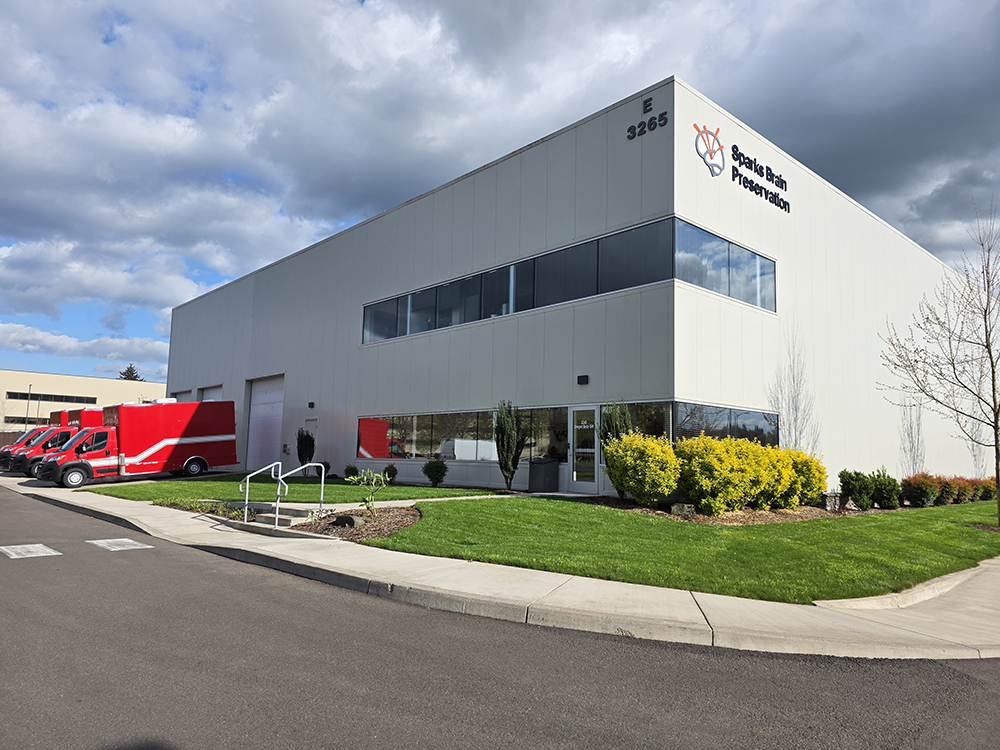
Structural information preservation for future revival
PrimarySparks Brain Preservation's central causal theory is that a person's future revival may depend less on preserving current biological viability and more on preserving the brain's information-bearing physical structure. If long-term memory, identity-relevant neural connectivity, and other person-specific features are encoded in stable molecular or ultrastructural brain architecture, then aldehyde fixation that preserves this architecture could retain the information needed for future medical or reconstruction technologies to restore the person.
Testable predictions include: preserved brains should retain synaptic, cellular, and subcellular structures at resolutions relevant to memory and connectomic information; neuroscience experts should identify structural substrates as central to long-term memory; and better preservation of these structures should increase the theoretical recoverability of memory-relevant information compared with poorly preserved postmortem tissue.
publication · Wed Jun 24 2026 07:45:50 GMT+0000 (Coordinated Universal Time) ·
SourcePopperian evaluation
Premise plausibility6.0
The core premise is credible but incomplete: long-term memory and person-specific identity almost certainly depend on physical brain structure, including synapses, cells, and subcellular organization. The weak link is the jump from preserved structure to preserved recoverable personhood. We do not fully understand which molecular states matter for memory, how much loss is tolerable, or whether aldehyde-fixed tissue keeps enough of the right information after death and processing.
Supporting evidence: The evidence graph cites a 2025 neuroscientist survey on the structural basis of long-term memory.; Multiple brain banking and fixation papers report that cellular and ultrastructural preservation quality can be assessed.; The theory makes a biologically coherent claim: memory-relevant information must have some physical substrate.
Counter evidence: The future-revival step has low-confidence support in the evidence graph.; Preserving visible ultrastructure does not prove that all identity-relevant molecular states survive fixation.; No cited evidence shows actual restoration of memory, cognition, or personal continuity from preserved human brain tissue.
Explanatory power5.0
The theory explains why aldehyde fixation and rapid postmortem preservation would matter: if the relevant target is information-bearing brain structure, then procedures that preserve synapses and ultrastructure should beat poorly preserved tissue. That part hangs together. It does not yet explain the harder outcome, revival, better than simpler explanations such as: fixation is useful for research because it preserves morphology, while biological recovery remains unavailable.
Supporting evidence: The theory predicts that better-preserved brains should retain synaptic, cellular, and subcellular structures at memory-relevant resolution.; The evidence context includes studies on immersion fixation, mechanical perfusion, and ultrastructural quality in banked brain tissue.; The legal and operational implication, rapid preservation before structural degradation, follows directly from the theory.
Counter evidence: Good morphology can explain brain banking quality without implying future revival.; The evidence does not show that preserved structure is sufficient for reconstructing memories or identity.; Alternative accounts need fewer assumptions: fixation preserves research-grade anatomy, but the person is not recoverable.
Falsifiability7.0
The near-term claims are testable. Researchers can compare preserved brains against degraded tissue, quantify synaptic and ultrastructural retention, and ask whether known memory-associated structures survive at the needed scale. The far-term revival claim is much harder to falsify because it can retreat into future technology. The theory is strongest when it stays with measurable preservation quality, weaker when it asks us to wait for reconstruction tools that do not exist yet.
Supporting evidence: The theory predicts retained synaptic, cellular, and subcellular structures at relevant resolutions.; Brain banking studies can assess cellular and ultrastructural quality directly.; The theory predicts that better preservation should increase theoretical recoverability compared with poorly preserved postmortem tissue.
Counter evidence: The required threshold for memory-relevant preservation is not specified.; Future medical or reconstruction technology is an open-ended condition, which makes the full revival claim difficult to disprove now.; Expert agreement that structure matters would support the premise, but would not prove that preserved tissue contains enough information for revival.
Reasoning tree
derivationA person's future revival may depend more on preserving the brain's information-bearing physical structure than on preserving current biological viability.
medium confidence - 3 linked evidence items
assumptionassumes
Long-term memory, identity-relevant neural connectivity, and other person-specific features are encoded in stable molecular or ultrastructural brain architecture.
medium confidence - 3 linked evidence items
premiseimplies
Structural substrates of the brain, including synaptic, cellular, and subcellular organization, are relevant carriers of memory and connectomic information.
medium confidence - 3 linked evidence items
predictionpredicts
Neuroscience experts should identify structural substrates as central to long-term memory.
high confidence - 1 linked evidence item
premiserequires
Aldehyde fixation can preserve brain architecture relevant to structural information retention.
medium confidence - 4 linked evidence items
observationobserved_in
Brain banking and fixation methods can be assessed for their preservation of cellular and ultrastructural quality.
high confidence - 4 linked evidence items
derivationimplies
If fixation preserves the physical structures that encode person-specific information, then the preserved brain may retain information needed by future medical or reconstruction technologies.
medium confidence - 3 linked evidence items
assumptionassumes
Future medical or reconstruction technologies may become capable of using preserved structural brain information to restore or revive a person.
low confidence - 3 linked evidence items
predictionpredicts
Preserved brains should retain synaptic, cellular, and subcellular structures at resolutions relevant to memory and connectomic information.
high confidence - 4 linked evidence items
predictionpredicts
Better preservation of memory-relevant brain structures should increase theoretical recoverability of person-specific information compared with poorly preserved postmortem tissue.
medium confidence - 4 linked evidence items
project_implicationimplies
The preservation project should prioritize procedures that maximize retention of information-bearing brain structure rather than only procedures that maintain immediate biological viability.
medium confidence - 3 linked evidence items
project_implicationrequires
Legal and operational systems should enable rapid preservation when delay would degrade information-bearing brain structure.
medium confidence - 3 linked evidence items
Public endorsements
silent
There is no public evidence here linking Alexander Parra to this theory. The evidence bundle contains no quotes, records, or publications, so we cannot show that he endorses, mentions, or contradicts the claim about structural information preservation for future revival.
publicly endorses
Andrew McKenzie publicly presents Sparks Brain Preservation's information-preservation view in his December 13, 2025 talk. The record summary says he explains the distinction between suspended animation and information preservation, why Sparks focuses on information preservation, and why the group believes aldehyde fixation makes the most sense for preserving the brain structure needed for future revival.
silent
No public evidence is provided here. The dossier includes no quotes, records, or publications from Autumn Beck addressing Sparks Brain Preservation's theory, so the defensible classification is silence rather than endorsement, mention, or contradiction.
silent
The evidence here is a patent on organ and cellular product preservation, credited to Michael J. Taylor, not a public statement from Gabriel Taylor about brain ultrastructure, memory encoding, or future revival. On this record, there is no public endorsement, mention, or contradiction of Sparks Brain Preservation's theory.
silent
The public theory is stated by the company website and in a Sparks Brain Preservation talk by Dr. Andrew McKenzie, both of which argue for information-preserving structural fixation. But the dossier does not give a public statement from Jordan Sparks himself endorsing, discussing, or disputing that theory. The only Jordan-specific record here is an event listing saying he would speak about his project, which is too thin to count as a theory endorsement.
Information preservation for future revival
PrimarySparks Brain Preservation's core causal theory is that preserving the molecular and ultrastructural architecture of the brain can preserve the information needed for personal identity, memories, and mind-relevant function, even if the person cannot be biologically revived with present-day medicine. The intervention is framed as a bridge: aldehyde-based structural preservation may keep brain information intact long enough for future medical or molecular technologies to repair, emulate, or otherwise revive the preserved person.
Testable predictions include that preserved brains should retain synaptic, cellular, and molecular-scale structural features thought to encode long-term memory; that better preservation of these structures should correlate with higher estimated recoverability of neural information; and that future revival feasibility should depend more on retained informational structure than on current biological viability.
publication · Mon Jun 22 2026 10:36:58 GMT+0000 (Coordinated Universal Time) ·
SourcePopperian evaluation
Premise plausibility6.0
The core premise is credible at the structural level, but incomplete at the person level. Neuroscience already treats long-term memory as strongly tied to durable synaptic, cellular, and molecular brain structure, and the cited preservation work directly asks whether those structures survive fixation, perfusion, banking, or cryopreservation. The hard gap is identity: preserving architecture may preserve many memory-relevant traces, but we do not fully understand which molecular states, dynamic patterns, glial contributions, epigenetic marks, or network-scale features are necessary for a future person to count as the same person. The theory is coherent. It is not proven.
Supporting evidence: The theory cites a 2025 survey of neuroscientists on the structural basis of long-term memory, supporting the claim that memory is at least partly stored in durable physical brain features.; The 2024 structural brain preservation paper frames preservation as a possible bridge to future medical technologies.; 2025 and 2026 brain-banking studies evaluate retained cellular and ultrastructural features after fixation, perfusion, and postmortem handling.
Information-preservation bridge to future revival
PrimarySparks Brain Preservation's central causal theory is that preserving the brain's molecular and structural architecture may preserve the information necessary for personal identity, memory, and cognition, creating a possible bridge to future revival technologies. The proposed healthspan/lifespan relevance is not near-term biological rejuvenation; it is post-mortem or peri-mortem preservation intended to prevent irreversible information loss until future repair or revival methods exist.
A testable prediction is that aldehyde-fixed preserved brains should retain fine-scale neural and molecular structure, including ultrastructural features visible by volume electron microscopy, better than untreated decomposition or poorly preserved tissue. A further prediction is that if future technologies can infer or repair function from preserved neural architecture, individuals preserved with this method would have a greater chance of revival than individuals whose brain structure degraded after death.
company website · Wed Jun 10 2026 05:21:25 GMT+0000 (Coordinated Universal Time) ·
SourcePopperian evaluation
Premise plausibility6.0
The core premise is plausible in its narrow form: memory and identity likely depend on physical brain features, and aldehyde fixation can preserve some fine-scale structure well enough to inspect it. The weak link is the leap from preserved structure to preserved person. We do not fully understand which molecular, synaptic, epigenetic, glial, and dynamic states are necessary for identity or cognition, so the theory rests on a real but incomplete map.
Supporting evidence: The evidence context cites neuroscientist survey work on the structural basis of long-term memory.; Brain banking studies report that preserved tissue can be assessed for cellular, ultrastructural, and molecular features.; The theory separates near-term biological rejuvenation from preservation after death or near death, which avoids claiming an immediate healthspan effect.
Counter evidence: The identity-relevant information set is not fully known.; Future repair or revival from preserved architecture is an assumption with low confidence in the evidence graph.; Rapid preservation after death depends on legal, logistical, and technical processes that may fail before relevant structure is fixed.
Immediate preservation improves information retention
The legal and operational focus on immediate preservation reflects a causal theory that delays after death reduce the quality of brain preservation by allowing ischemia, autolysis, decomposition, and handling-related damage to progress before fixation. Therefore, removing legal or procedural barriers to rapid preservation should improve the probability that brain architecture remains sufficiently intact for long-term storage and possible future revival.
Testable predictions include: longer death-investigation or custody delays should be associated with poorer preservation quality; cases with faster access to preservation should show better cellular and ultrastructural outcomes; and policies that permit immediate preservation should increase the fraction of cases meeting predefined structural preservation criteria.
publication · Wed Jun 24 2026 07:45:50 GMT+0000 (Coordinated Universal Time) ·
SourcePopperian evaluation
Premise plausibility8.0
The core premise is credible: after death, ischemia, autolysis, decomposition, and handling damage have more time to alter brain tissue before fixation. The weaker step is the jump from better preserved structure to future revival-relevant information. Brain architecture plausibly carries memory-relevant information, but we do not yet know which structural features would be sufficient for identity, memory, or recovery.
Supporting evidence: The evidence context rates the claim that postmortem delays reduce brain preservation quality as high confidence.; Technical reports and 2025 brain-banking studies describe methods for assessing cellular and ultrastructural preservation.; The theory names concrete damage processes: ischemia, autolysis, decomposition, and handling-related damage.
Counter evidence: The revival-relevance of preserved brain architecture is only medium confidence in the supplied reasoning graph.; Predefined structural preservation criteria are proxies, not direct measures of retained personal identity or recoverable memory.
Ultrastructural validation as evidence of preserved revival-relevant information
Sparks' use of volume electron microscopy implies a causal-evidence theory: if the intervention's purpose is to preserve brain architecture, then direct ultrastructural imaging can test whether the relevant structures survived preservation. Volume electron microscopy does not itself extend lifespan, but it functions as a validation layer linking the preservation intervention to the claimed future-revival rationale.
Testable predictions include: tissue preserved by Sparks' methods should show high-quality ultrastructural preservation across sampled brain regions; volume electron microscopy should reveal intact or interpretable cellular boundaries, synaptic structures, and fine architecture; and preservation methods that score better on ultrastructural metrics should be more credible candidates for retaining the information required by future repair or reconstruction technologies.
publication · Wed Jun 24 2026 07:45:50 GMT+0000 (Coordinated Universal Time) ·
SourcePopperian evaluation
Premise plausibility8.0
The core premise is credible: if a preservation method claims to retain brain architecture, direct ultrastructural imaging is a relevant test of that claim. The biological bet is narrower and weaker than full revival: it says cellular boundaries, synapses, and fine architecture carry at least part of the information future repair would need. That is plausible, but incomplete. We do not know the full information set required to reconstruct a person, and volume electron microscopy cannot tell us whether all functionally relevant molecular states survived.
Supporting evidence: The evidence graph assigns high confidence to the claim that direct ultrastructural preservation is relevant evidence for retained revival-relevant information.; Volume electron microscopy can image preserved brain tissue at ultrastructural resolution across sampled volumes.; The theory separates validation from treatment: volume electron microscopy does not itself extend lifespan or revive tissue.
Counter evidence: The link between preserved structure and future revival remains partly assumed, with medium confidence for the claim that required information is encoded in cellular boundaries, synapses, and fine architecture.; Sampled ultrastructure may miss molecular, regional, or functional information that future repair would require.
Aldehyde fixation prevents postmortem structural loss
The company frames aldehyde fixation as a practical mechanism for preserving brain molecular architecture because aldehydes chemically stabilize biological tissue, a long-standing method in neuroscience for structural preservation. The causal claim is that rapid fixation after death can halt or slow autolysis, decomposition, and diffusion-driven loss of fine cellular structure, thereby preserving more of the brain's information-bearing architecture than delayed or less structurally stabilizing handling.
Testable predictions include: shorter postmortem intervals and effective perfusion or immersion fixation should correlate with better cellular and ultrastructural preservation; fixed brain tissue should show preserved membranes, synapses, organelles, and other fine structures under microscopy; and fixation protocols optimized for whole-brain preservation should outperform uncontrolled postmortem storage on structural quality metrics.
company website · Wed Jun 24 2026 07:45:50 GMT+0000 (Coordinated Universal Time) ·
SourcePopperian evaluation
Premise plausibility8.0
The core premise is credible: aldehydes chemically stabilize tissue, and aldehyde fixation has a long history in neuroscience and brain banking for preserving cellular structure. The stronger claim, that this preserves the brain's information-bearing architecture after death, rests on a plausible but still incomplete bridge: long-term memory likely depends on fine molecular, cellular, and synaptic structure, but we do not yet know the full encoding target.
Supporting evidence: The evidence graph lists aldehyde chemical stabilization of biological tissue as high confidence.; Aldehyde fixation is described as a long-standing neuroscience method for structural preservation.; Brain banking reports support immersion fixation and mechanical perfusion as methods that can preserve or assess cellular structure.
Counter evidence: The memory-architecture premise is only medium confidence, because the exact physical substrate of long-term personal identity and memory is not fully specified.; Fixation can preserve structure while still altering molecules, antigenicity, or fine biochemical states relevant to future interpretation.
Rapid legal access improves preservation outcome
The legal-barriers work implies a causal theory that delays after death reduce preservation quality, and that legal or procedural access to immediate preservation can improve the chance that brain structure remains recoverable. Under this theory, death investigation delays and other barriers are not merely administrative problems; they causally increase postmortem degradation before fixation can stabilize tissue.
Testable predictions include that longer postmortem intervals should correlate with worse ultrastructural preservation, that policies enabling faster release or immediate preservation should improve preservation metrics, and that cases with delayed preservation should require more caveats about future revival potential.
publication · Mon Jun 22 2026 10:36:58 GMT+0000 (Coordinated Universal Time) ·
SourcePopperian evaluation
Premise plausibility8.0
The core premise is credible: brain tissue degrades after death, and fixation can only stabilize the structure that remains when preservation begins. The theory also fits the legal premise: death investigation and release procedures can add delay before preservation starts. The weaker link is the jump from preserved ultrastructure to future recoverability. That link is plausible enough to matter, but we do not fully understand which exact physical features would be sufficient for revival.
Supporting evidence: The reasoning nodes cite multiple 2024 to 2025 brain banking and preservation papers linking postmortem interval to preservation quality.; The 2025 legal-barriers paper directly supports the claim that death investigation can delay access to immediate preservation.; The theory includes a biological mechanism: degradation proceeds before fixation stabilizes tissue.
Counter evidence: The evidence context gives no direct human revival data, so recoverability remains an inferred endpoint.; The structural basis of long-term memory is treated as a medium-confidence assumption, not settled ground.
Ultrastructural validation predicts preservation adequacy
Sparks' use of volume electron microscopy reflects a causal quality-control theory: if the intervention preserves the nanoscale brain structures visible by volume EM, then the preservation process is more likely to have retained the physical substrate needed for future reconstruction or revival. Volume EM is therefore not the longevity intervention itself, but a validation platform linking preservation quality to the plausibility of future recovery.
Testable predictions include that samples passing volume-EM ultrastructural criteria should show preserved membranes, synaptic organization, and cellular architecture across tissue volumes; that failed or delayed preservation should show measurable ultrastructural deterioration; and that volume-EM scoring should distinguish protocols with higher versus lower expected information retention.
publication · Mon Jun 22 2026 10:36:58 GMT+0000 (Coordinated Universal Time) ·
SourcePopperian evaluation
Premise plausibility8.0
The premise is credible: if future recovery depends on retained brain information, then membranes, synapses, and cellular architecture are plausible things to inspect. Volume electron microscopy can see those structures at the right physical scale, so the measurement platform matches the claim. The weak link is the hardest one: we do not fully know which nanoscale features are sufficient for identity, memory, or recoverable function. Preserved ultrastructure is a serious adequacy signal, but it is not proof of recoverability.
Supporting evidence: The evidence base states that preservation adequacy can be judged by physical integrity of nanoscale brain structures relevant to future reconstruction or revival.; The theory explicitly separates volume EM from the intervention: it is a validation platform, not the preservation or revival method.; Volume EM can directly visualize membranes, synapses, and cellular architecture across tissue volumes.
Counter evidence: The substrate needed for future recovery is described as partly encoded in nanoscale cellular and synaptic structure, with only medium confidence.; No cited evidence shows that passing volume-EM criteria is sufficient for future revival or reconstruction.
Aldehyde fixation stabilizes brain structure
The company's preservation approach rests on the causal claim that aldehyde fixation chemically stabilizes brain tissue and cross-links molecular structures quickly enough to prevent postmortem degradation of the cellular and synaptic architecture that may encode recoverable neural information. Because aldehyde fixation is described as a long-standing structural preservation method in neuroscience, Sparks treats it as better aligned with information preservation than approaches aimed primarily at maintaining suspended biological viability.
Testable predictions include that aldehyde-fixed brains should show less postmortem ultrastructural disruption than inadequately fixed or delayed-preservation controls; that key cellular compartments, membranes, synapses, and tissue morphology should remain evaluable after storage; and that shorter postmortem intervals or better perfusion/fixation protocols should improve preservation quality.
company website · Mon Jun 22 2026 10:36:58 GMT+0000 (Coordinated Universal Time) ·
SourcePopperian evaluation
Premise plausibility8.0
The core premise is credible: aldehyde fixation cross-links molecular structures, and the evidence context treats that chemistry as well established in neuroscience and brain banking. The weaker step is the jump from preserved structure to recoverable neural information. That may be true in part, but we do not yet know which molecular and synaptic details are sufficient for future recovery.
Supporting evidence: The evidence rates as high confidence the premise that aldehyde fixation can chemically stabilize brain tissue by cross-linking molecular structures.; Aldehyde fixation is described as a long-standing structural preservation method in neuroscience and brain banking.; Predictions about preserved membranes, synapses, cellular compartments, and tissue morphology match the claimed mechanism.
Counter evidence: The claim that recoverable neural information remains encoded in preserved cellular, synaptic, and molecular structures is rated only medium confidence.; The evidence supports structural preservation more directly than future recovery of neural information.
Secure long-term storage prevents delayed information loss
The company's service model implies that preservation is only useful if the fixed brain remains protected from later degradation. Secure permanent storage is therefore part of the causal theory: aldehyde fixation initially stabilizes architecture, and long-term controlled storage maintains that preserved state until future technologies might make revival possible.
A testable prediction is that stored preserved brains should retain ultrastructural quality over long periods, with minimal degradation compared with improperly stored or unstored fixed tissue. The provided material does not include detailed long-term quantitative outcome data, so this theory is less directly supported than the fixation mechanism itself.
company website · Wed Jun 10 2026 05:21:25 GMT+0000 (Coordinated Universal Time) ·
SourcePopperian evaluation
Premise plausibility7.0
The premise is biologically credible: fixation can stabilize brain architecture, and storage conditions can determine whether that fixed structure survives. The weak point is duration. The evidence context says long-term controlled storage must preserve ultrastructure until future revival technology exists, but it does not provide detailed quantitative data showing preserved brains remain stable over long periods.
Supporting evidence: Aldehyde fixation initially stabilizes brain architecture, with high-confidence support from preservation and brain-banking publications.; The theory correctly treats storage as causally necessary, because preservation fails if later degradation destroys the stored structural information.; Fluid preservation and banked brain tissue quality publications are cited as relevant support for storage-dependent preservation.
Counter evidence: The provided material does not include detailed long-term quantitative outcome data on stored preserved brains.; The revival premise remains low-confidence: future technologies might make revival possible, but that is an assumption rather than demonstrated biology.
Volume electron microscopy validates preservation fidelity
Sparks' validation theory is that volume electron microscopy can directly assess whether the preservation method has retained the brain ultrastructure that matters for information preservation. The causal chain is: aldehyde fixation preserves physical brain architecture; volume electron microscopy measures preservation quality; sufficiently preserved ultrastructure provides evidence that the intervention may maintain information needed for possible future revival.
A testable prediction is that preserved samples should demonstrate high-quality structural continuity across three-dimensional brain volumes rather than isolated intact regions. If volume electron microscopy reveals widespread disruption, membrane loss, or structural collapse, that would weaken the preservation mechanism.
company website · Wed Jun 10 2026 05:21:25 GMT+0000 (Coordinated Universal Time) ·
SourcePopperian evaluation
Premise plausibility7.0
The premise is credible as a validation claim: aldehyde fixation can preserve physical brain architecture, and volume electron microscopy can inspect three-dimensional ultrastructure. The weak step is the bridge from visible ultrastructure to preserved person-relevant information. That bridge is plausible, but still an assumption. We do not fully know which physical features must survive for future revival to be possible.
Supporting evidence: The evidence context rates the claim that volume electron microscopy can measure preservation quality across three-dimensional brain tissue volumes as high confidence.; Aldehyde fixation preserving physical brain architecture after death is listed as a medium-confidence premise.; The theory names specific failure modes: widespread disruption, membrane loss, and structural collapse.
Counter evidence: The claim that volume electron microscopy-visible features include the structures that matter for preserving brain information is only medium confidence.; Structural continuity in sampled volumes may not fully represent preservation quality across the whole treated brain.
Aldehyde fixation stabilizes brain architecture
The company's mechanistic claim is that aldehyde fixation chemically stabilizes brain tissue in a way that preserves molecular architecture and fine structure. Sparks describes aldehyde fixation as a long-standing structural preservation method in neuroscience, implying that crosslinking or fixation prevents post-mortem degradation of brain structure that would otherwise erase information relevant to future revival.
A testable prediction is that aldehyde-fixed tissue should show preserved cellular and subcellular organization under volume electron microscopy, including intact structural detail after preservation and storage. This supports the company's claim only if fixation quality is sufficient across human-scale brains, not merely small tissue samples.
company website · Wed Jun 10 2026 05:21:25 GMT+0000 (Coordinated Universal Time) ·
SourcePopperian evaluation
Premise plausibility7.0
The core premise is credible: aldehyde fixation is a standard neuroscience method for stabilizing tissue, and the evidence context says it can preserve cellular and subcellular structure. The weaker step is the jump from preserved architecture to revival-relevant information. That may be true in part, especially for connectivity and synaptic structure, but we do not fully understand which molecular states would need to survive for a future revival attempt.
Supporting evidence: Aldehyde fixation is described as a long-standing structural preservation method in neuroscience.; The theory predicts preserved cellular and subcellular organization under volume electron microscopy.; Banked or experimentally preserved brain tissue can be assessed for ultrastructural preservation quality using microscopy.
Counter evidence: The claim depends on fixation quality across whole human brains, not only small tissue samples.; The evidence context treats revival-relevant information as an assumption, with medium confidence.