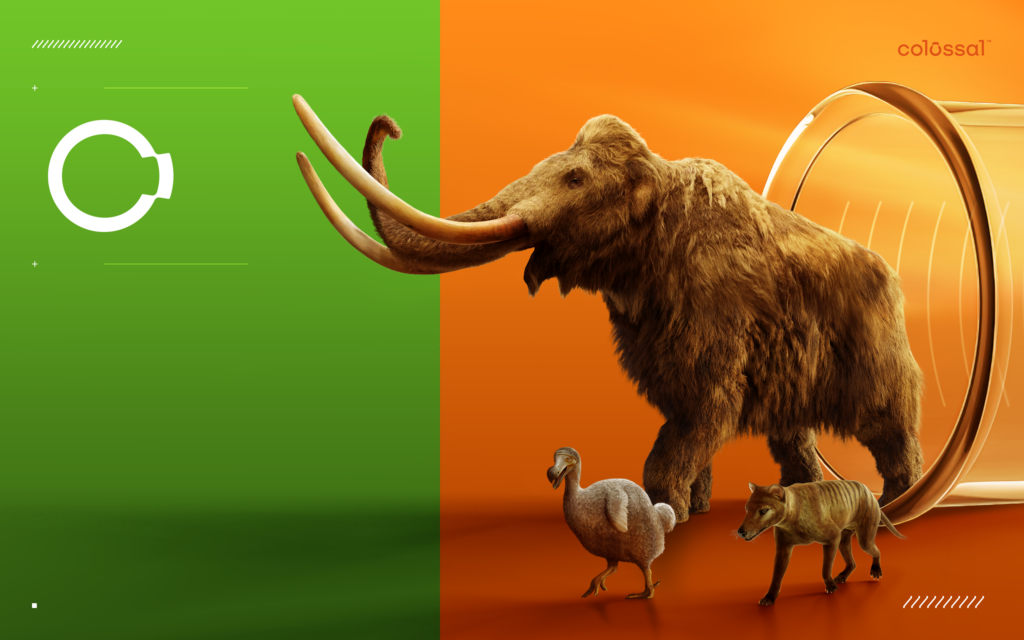
Animal Cloning, Cryopreservation, and Reanimation Platform
undisclosedplatform · high · Wed Nov 05 2025 00:00:00 GMT+0000 (Coordinated Universal Time)
Advance Colossal's de-extinction and species preservation capabilities using animal cloning, cryopreservation, and reproductive technologies.
Proprietary cloning, cryopreservation, reanimation, and advanced reproductive technologies acquired through Viagen.
Colossal Biosciences announced acquisition of Viagen, described as a leader in animal cloning, on November 5, 2025.
The acquisition was described as expanding Colossal's species preservation platform with Viagen's cloning, cryopreservation, and reanimation technologies.
De-extinction and Species Preservation Platform
exploratoryplatform · high · Wed Nov 05 2025 00:00:00 GMT+0000 (Coordinated Universal Time)
Create technologies for species restoration, critically endangered species protection, biodiversity preservation, and repopulation of ecosystems.
CRISPR/gene editing, genome sequencing and engineering, assisted reproductive technologies, stem cell biology, reintroduction science, AI, cloning, cryopreservation, and reanimation technologies.
Colossal acquired Viagen on November 5, 2025, adding proprietary cloning, cryopreservation, and reanimation technologies to its de-extinction and species preservation platform.
A 2025 review described de-extinction technologies as applicable to conservation and de-endangerment, expanding the conservation toolkit beyond resurrection of extinct species.
Artificial Womb Technology for Wildlife Conservation
exploratoryresearch program · medium · Mon Jan 13 2025 00:00:00 GMT+0000 (Coordinated Universal Time)
Advance animal reproductive technologies for wildlife conservation.
Funding of Wyss Institute research to develop artificial womb technology for animal reproduction and conservation use cases.
The Colossal Foundation donated $1.5 million to the Wyss Institute at Harvard University to advance artificial womb technology for wildlife conservation.
De-Extinction and Conservation Technology Platform
exploratoryplatform · high · Wed Jan 01 2025 00:00:00 GMT+0000 (Coordinated Universal Time)
Create a general technology toolkit for de-extinction, de-endangerment, biodiversity preservation, reintroduction, rewilding, and ecosystem monitoring.
Genome sequencing, genome engineering, assisted reproductive technologies, stem cell biology, reintroduction science, and artificial intelligence.
A 2025 review synthesized de-extinction technologies and their application to conservation biology.
The review describes de-extinction technologies as applicable beyond resurrecting extinct species, including conservation and de-endangerment applications.
Dodo De-Extinction Program
exploratoryresearch program · high · Wed Jan 01 2025 00:00:00 GMT+0000 (Coordinated Universal Time)
Develop a de-extinction path for the dodo and related avian conservation applications.
Avian genomics, comparative genomics, chromosome-level genome assembly of the Nicobar pigeon, and de-extinction technology.
Colossal announced its plan to de-extinct the dodo and launched an Avian Genomics Group; a 2025 chromosome-level genome of the Nicobar pigeon, the closest living relative of the dodo, was published.
The Nicobar pigeon assembly produced haplotype-resolved chromosome-level genomic resources intended to support evolutionary studies and future conservation work relevant to dodo de-extinction.
Woolly Mammoth De-Extinction Program
exploratoryresearch program · high · Mon Jan 01 2024 00:00:00 GMT+0000 (Coordinated Universal Time)
Restore or recreate woolly mammoth traits and evaluate ecological rewilding potential for Arctic megafaunal restoration.
Advanced genetics, genome engineering, de-extinction technology, and habitat/forage modeling using a woolly mammoth proxy.
Colossal launched with funding to bring back woolly mammoths; 2024 research assessed contemporary Arctic habitat availability for a woolly mammoth proxy.
Alaska's North Slope was conservatively estimated to support woolly mammoth proxy densities of 0.0-0.38 animals per km2, with a mean of 0.13, across habitats.
Thylacine De-Extinction Program
exploratoryresearch program · medium · Tue Jan 31 2023 00:00:00 GMT+0000 (Coordinated Universal Time)
Advance de-extinction work for the thylacine, also known as the Tasmanian tiger.
De-extinction technology using genomics and synthetic biology approaches.
Public materials list Thylacine in Colossal's pipeline, and a 2023 public record described massive progress on the Tasmanian tiger program.
Bluebuck
undisclosedresearch program · medium
Develop de-extinction technology for the Bluebuck.
Advanced genetics and de-extinction technology; specific methods are not described in the supplied material.
Listed in Colossal's pipeline.
Bluebuck De-extinction Program
undisclosedresearch program · medium
Use de-extinction technology to restore or recreate a bluebuck-like species.
Advanced genetics and gene editing to rebuild DNA of an extinct target species.
Listed by Colossal as a target species in its de-extinction pipeline.
Bluebuck De-Extinction Program
undisclosedresearch program · medium
Develop de-extinction or restoration technology for bluebuck.
Advanced genetics and de-extinction technology.
Bluebuck is listed in Colossal's public pipeline.
Conservation Genomics Program
exploratoryresearch program · medium
Generate genomic resources that support assessments of genetic diversity, adaptation, conservation management, and comparative genomics in vulnerable or extinct-related species.
De novo high-quality genome assembly using long-read PacBio HiFi sequencing, Omni-C or Hi-C data, and chromosome-level assembly pipelines.
A 2024 publication reported a chromosome-level genome assembly for the dugong, and a 2025 publication reported a chromosome-level genome assembly for the Nicobar pigeon.
The dugong assembly reached chromosome-level contiguity with 24 chromosome-level scaffolds and 97.9% complete BUSCOs; the Nicobar pigeon assembly provides a comparative resource for Dodo-related evolutionary studies and conservation.
De-extinction and Species Restoration Platform
exploratoryplatform · high
Build a technology platform for de-extinction, species restoration, de-endangerment, and conservation biology applications.
Genome sequencing, genome engineering, advanced assisted reproductive technologies, stem cell biology, reintroduction science, artificial intelligence, and ecosystem monitoring.
A 2025 review synthesized de-extinction technologies and their application to conservation and biodiversity preservation.
The review described de-extinction as both a route to restoring lost ecological functions and a broader conservation toolkit for sustaining and rebuilding biodiversity.
De-extinction Technology Platform
exploratoryplatform · high
Create a broadly applicable de-extinction and conservation toolkit for restoring lost ecological functions and supporting de-endangerment of threatened species.
Genome sequencing, genome engineering, advanced assisted reproductive technologies, stem cell biology, reintroduction science, artificial intelligence, rewilding, and ecosystem monitoring.
A 2025 Journal of Heredity review synthesized de-extinction technologies and their application to conservation biology.
The review argues that de-extinction technologies can expand the conservation toolkit beyond resurrecting extinct species to support biodiversity preservation and ecosystem restoration.
Dire Wolf
undisclosedresearch program · medium
Develop de-extinction technology for the Dire Wolf.
Advanced genetics and de-extinction technology; specific methods are not described in the supplied material.
Listed in Colossal's pipeline.
Dire Wolf De-extinction Program
undisclosedresearch program · medium
Use de-extinction technology to restore or recreate a dire wolf-like species.
Advanced genetics and gene editing to rebuild DNA of an extinct target species.
Listed by Colossal as a target species in its de-extinction pipeline.
Dire Wolf De-Extinction Program
undisclosedresearch program · medium
Develop de-extinction or restoration technology for the dire wolf.
Advanced genetics and de-extinction technology.
Dire Wolf is listed in Colossal's public pipeline.
Dodo
exploratoryresearch program · high
Support de-extinction and conservation research related to the extinct Dodo and its closest living relatives.
Comparative genomics and chromosome-level genome assembly of the Nicobar pigeon, the closest living relative of the Dodo.
A 2025 Journal of Heredity paper reported a haplotype-resolved, chromosome-level genome assembly of the Nicobar pigeon.
The assembly spans approximately 1.2 Gb per haplotype and provides a genomic resource for phylogenetic, evolutionary, and conservation studies involving the Dodo lineage.
Dodo De-extinction Program
exploratoryresearch program · high
Develop genomic resources and de-extinction methods relevant to recreating or restoring a dodo-like species.
Comparative genomics using the Nicobar pigeon, the closest living relative of the extinct dodo, plus advanced sequencing and gene-editing-enabled de-extinction methods.
A 2025 chromosome-level genome assembly of the Nicobar pigeon was published as a resource for evolutionary studies of the dodo and related extinct species.
The Nicobar pigeon assembly produced two approximately 1.2 Gb haplotypes with chromosome-level scaffolding, supporting phylogenetic and conservation genomics work.
Dugong Conservation Genomics
exploratoryresearch program · medium
Generate genomic resources to support conservation management and comparative genomics for dugong populations.
De novo chromosome-level genome assembly using long-read PacBio HiFi sequencing and Omni-C data following the Vertebrate Genome Project pipeline.
A 2024 Journal of Heredity paper presented a high-quality chromosome-level genome assembly for the dugong.
The assembly reached 24 chromosome-level scaffolds, 3.16 Gbp, and 97.9% complete BUSCOs; analyses suggested historical population decline and no evidence of ongoing recent inbreeding in the sampled individual.
Dugong Conservation Genomics Program
exploratoryresearch program · medium
Generate genomic resources to support conservation management, range-wide genetic diversity assessment, adaptation studies, and comparative genomics for dugong populations.
De novo chromosome-level genome assembly using PacBio HiFi sequencing, Omni-C data, and the Vertebrate Genome Project pipeline.
A 2024 Journal of Heredity paper reported a chromosome-level 3.16 Gbp dugong genome assembly with 24 chromosome-level scaffolds and 97.9% complete BUSCOs.
The study found relatively high genome-wide heterozygosity, demographic decline after the last interglacial period, no evidence of ongoing recent inbreeding in the sampled individual, and some past inbreeding from runs of homozygosity.
Moa
undisclosedresearch program · medium
Develop de-extinction technology for the Moa.
Advanced genetics and de-extinction technology; specific methods are not described in the supplied material.
Listed in Colossal's pipeline.
Moa De-extinction Program
undisclosedresearch program · medium
Use de-extinction technology to restore or recreate a moa-like species.
Advanced genetics and gene editing to rebuild DNA of an extinct target species.
Listed by Colossal as a target species in its de-extinction pipeline.
Moa De-Extinction Program
undisclosedresearch program · medium
Develop de-extinction or restoration technology for moa.
Advanced genetics and de-extinction technology.
Moa is listed in Colossal's public pipeline.
Protective Alleles in Crewed Spaceflight
exploratorybiomarker · medium
Identify naturally occurring human protective alleles relevant to aerospace medicine, including decreased cancer risk and improved bone, muscular, and cardiovascular health.
Review and annotation of common and rare alleles across human genomes with relevance to crew health in deep space missions.
A 2024 Nature Communications paper reviewed protective alleles and their possible application to precision healthcare in crewed spaceflight.
The paper identified protective mechanisms that could inform nutrition, exercise, and health recommendations for crew members during deep space missions.
Thylacine
undisclosedresearch program · medium
Develop de-extinction technology for the Thylacine.
Advanced genetics and de-extinction technology; specific methods are not described in the supplied material.
Listed in Colossal's pipeline.
Thylacine De-extinction Program
undisclosedresearch program · medium
Use de-extinction technology to restore or recreate a thylacine-like species for conservation and ecosystem restoration purposes.
Advanced genetics and gene editing to rebuild DNA of an extinct target species.
Listed by Colossal as a target species in its de-extinction pipeline.
Woolly Mammoth
exploratoryresearch program · high
Develop de-extinction technology for the Woolly Mammoth and assess ecological feasibility for Arctic megafaunal rewilding.
Advanced genetics, genome engineering, de-extinction technology, and habitat/forage modeling using a woolly mammoth proxy.
A 2024 Scientific Reports study assessed contemporary Arctic habitat availability for a woolly mammoth proxy on Alaska's North Slope.
The study conservatively estimated Alaska's North Slope could support densities of 0.0-0.38 woolly mammoth per km2, with a mean of 0.13, across a variety of habitats.
Woolly Mammoth De-extinction Program
exploratoryresearch program · high
Develop de-extinction technology to recreate a woolly mammoth proxy and support Arctic ecosystem restoration or rewilding strategies.
Advanced gene editing and de-extinction biology; habitat and forage modeling for mammoth-proxy rewilding.
A 2024 study assessed contemporary Arctic habitat availability and estimated Alaska's North Slope could support 0.0-0.38 woolly mammoth proxies per square kilometer, with a mean of 0.13.
Modeling suggested limited but nonzero contemporary habitat capacity for a woolly mammoth proxy across some North Slope habitats.