R42 Group appears to be a U.S.-based, founder-led venture platform and family-office-derived group centered on AI, biotech, and longevity, with an adjacent education/community arm (R42 Institute). The strongest evidence supports investing activity, network-building, and public positioning around AI-plus-longevity rather than validated scientific breakthroughs or clinical outcomes. Reported signals include a $16M AI and Longevity Fund, named investments such as Fountain Therapeutics and Healx, and a 2025 XPRIZE Healthspan semifinalist mention for an R42 approach described as gene therapy plus AI-guided systems biology, but most claims are self-reported, interview-based, directory-sourced, or promotional.
Comprehensive brief
Hypothesis
R42 Group’s implicit hypothesis is that early, hands-on capital deployment plus AI-heavy scientific framing can identify, create, and accelerate longevity companies faster than conventional biotech investing alone, especially at the intersection of mathematics, biology, and deep tech.
Mechanism
The mechanism is organizational rather than experimentally proven: source deals from universities and early teams, invest small checks early, provide advisory and network support through R42 Group and R42 Institute, and back platforms or companies using AI in areas such as drug discovery, diagnostics, robotics, and potentially gene-therapy-oriented longevity programs. One project-specific scientific signal is the XPRIZE Healthspan semifinalist description of R42’s approach as 'gene therapy and AI-guided systems biology,' but the evidence does not explain the underlying biological mechanism or show results.
Approach
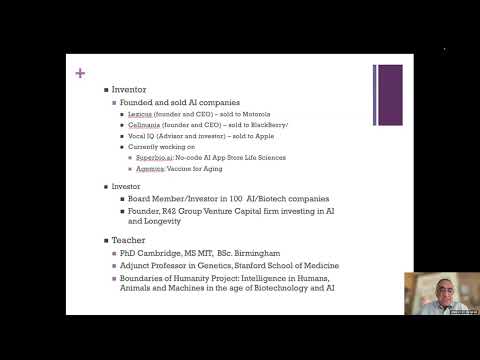
Best classified as applied infrastructure: R42 presents itself as inventing, investing, and informing across AI, longevity, and biotech; it appears to operate as a venture platform, family office, and educational/community hub rather than as a single therapeutic program. Concrete evidence supports financing and board participation in longevity-adjacent companies more than direct ownership of validated therapeutics.
Status
Active but weakly validated. Evidence supports that R42 has public-facing leadership, a team page, an institute, a reported seed fund, and participation in financings such as Fountain Therapeutics (2021) and Healx (2024), with Ronjon Nag joining the Healx board. A 2025 news item places R42 among XPRIZE Healthspan semifinalists, implying an active intervention concept, but there is no project-level protocol, trial readout, audited portfolio performance, or independent evidence of efficacy for R42’s own longevity claims.
Success criteria
Success would mean more than brand visibility or deal flow. In the next few years, credible proof would include independently verifiable portfolio outcomes in longevity-relevant companies, successful follow-on financings tied to technical progress, disclosed technical milestones for any in-house programs, and especially human-relevant evidence if R42’s gene-therapy/systems-biology work advances beyond competition selection into measurable functional improvement. Without that, the project remains mostly a thesis and network.
Near-term impact (1-3 yrs)
If R42’s central claim is validated in the next 1-3 years, the practical near-term impact would be better capitalization and formation of very early longevity startups, faster translation of AI-enabled biotech ideas into funded companies, and more concrete programs in areas already named in the evidence: AI drug discovery, rare-disease and degenerative-disease therapeutics, diagnostics, robotics for aging, and possibly early human-testing pathways for gene-therapy-oriented healthspan interventions. The most realistic short-term outcome is improved venture formation and pipeline selection, not broad lifespan extension.
Future horizons (5-20 yrs)
If the model truly works over 5-20 years, it could help normalize a new hybrid category between venture firm, incubator, and longevity research platform: organizations that combine capital, AI tooling, biology expertise, and education to repeatedly launch age-related therapeutics and diagnostics. That could open new subfields around AI-guided systems-biology intervention design, more investable longevity company formation from university science, and tighter links between aging biology, translational biotech, and founder training. The speculative upside is large, but current evidence does not justify assuming R42 itself will deliver it.
Scientific panel
Mechanism plausibility38
R42's directly evidenced mechanism is mostly organizational: invest in and help create AI, biotech, and longevity ventures. The biological mechanism for its own longevity work is not disclosed beyond broad claims such as AI for rare-disease drug discovery, an aging vaccine, mitochondrial therapies, and an XPRIZE-listed approach involving gene therapy plus AI-guided systems biology. Those components are plausible research areas, but the project-level causal chain from R42's platform to measurable human healthspan improvement is underspecified.
Evidence base34
The strongest project-specific evidence supports R42 as an active funder and venture platform, not as a validated scientific program. There is evidence of a $16M AI/longevity seed fund, participation in Fountain Therapeutics' financing, and co-leading Healx's Series C with a Phase 2 rare-disease program. These are meaningful adjacent signals, but they are portfolio/company-development evidence rather than direct data that R42's own longevity hypothesis works. The XPRIZE semifinalist mention is a weak early signal because no protocol or results are included here.
Methodological rigor12
No team-authored protocol, controlled experiment, statistical plan, pre-registration, trial design, or dataset description is provided for R42's own longevity claims. The available evidence is mainly a website, team/about pages, interviews, investment announcements, and third-party investor profiles. Healx's Phase 2 clearance supports methodological seriousness at a portfolio company, but it does not establish rigor for R42's central project-level thesis.
Reproducibility8
There is no evidence of independent replication of R42's own longevity method, nor evidence that R42 has repeatedly produced validated scientific or clinical healthspan outcomes. The portfolio and fund evidence shows activity and follow-on financing, but not reproducible biological results or replicated intervention effects.
Novelty48
R42 combines early-stage venture capital, AI, biotech, longevity education, and company creation; that combination is differentiated as a platform but not clearly novel scientifically. Its public claims include AI-enabled drug discovery, programmable biology, aging-vaccine language, and gene-therapy/systems-biology framing, which are frontier-adjacent but broad. The evidence does not show a new disclosed biological target, intervention, assay, or validated technical method unique to R42.
Falsifiability32
Some adjacent claims are testable, especially XPRIZE Healthspan's stated goal of restoring muscular, cognitive, and immune function in older adults within 12 months. But R42's own central thesis is broad and venture-platform-like, making it hard to falsify without predefined portfolio, biological, or clinical success criteria. The available evidence lacks specific predictions, endpoints, or timelines for R42-owned programs.
Breakthrough panel
Mechanism novelty34
R42's supported mechanism is mostly organizational: early capital, founder support, AI/longevity education, and portfolio formation. The evidence supports investment activity and an AI-plus-biology thesis, but not a disclosed proprietary biological mechanism or reproducible intervention. Gene-therapy or aging-vaccine language appears in project-facing/profile evidence, but without enough mechanistic detail to score as a clearly novel aging mechanism.
Effect size+1.5 yr lifespan★28 The plausible impact is indirect: R42 may accelerate AI-enabled biotech and longevity startups, but evidence does not show a validated R42 intervention that extends healthspan. Portfolio companies such as Fountain and Healx have aging-adjacent or disease programs, including preclinical/clinical development, but those are not proof that R42 itself can deliver a large lifespan effect. I anchor the raw longevity effect at the low end of the broad platform band.
Cross-domain impact48
There is credible cross-domain activity across AI, biotechnology, drug discovery, rare disease, education, and venture formation. R42 is documented as investing in AI/longevity companies, educating through R42 Institute, and participating in financings for Fountain and Healx. The current unlock is more ecosystem and translational financing than a new technical capability already adopted across fields.
Future opening potential52
If the R42 model works, it could open a repeatable hybrid category between venture firm, incubator, AI-biology advisory network, and longevity education platform. The evidence supports early-stage investing, fund formation, and claimed hands-on support from pre-seed through growth. The upside is meaningful, but it remains dependent on future portfolio outcomes rather than demonstrated breakthrough performance today.
R42 can produce demonstrable results sooner than a therapeutic developer because near-term milestones include financings, board roles, portfolio clinical progress, and fund deployment. Healx already had FDA clearance for a Phase 2 trial reported in 2024, and Fountain had preclinical/R&D financing in 2021. However, demonstrable longevity or healthspan impact would take much longer and is not yet shown.
Paradigm shift signal30
The paradigm-shift claim would be that founder-led AI-plus-longevity venture building can reliably create superior therapeutics and healthspan outcomes. The evidence does not yet invalidate mainstream biotech assumptions; it mainly shows a broad investment thesis, founder credentials, and portfolio participation. Strong claims such as AI-derived aging vaccines remain too promotional and under-evidenced here.
Investor panel
Most attractive
Asymmetric upside (76)If R42 becomes an early allocator and builder behind multiple AI-longevity winners, the upside is high: it targets pre-seed through growth, has a $16M seed fund aiming at many investments, and has exposure to AI drug discovery, rare disease, gene editing, aging vaccines, and other longevity-adjacent platforms. The score is capped because the evidence shows positioning and portfolio exposure more than direct ownership of a validated breakthrough.
Most concerning
Competitive freedom (36)The opportunity is crowded: field-context evidence shows many longevity, life-extension, AI, gene-therapy, and reprogramming efforts, and the XPRIZE item alone describes 100 semifinalist teams from 58 countries. R42’s broad thesis gives room to maneuver, but there is not enough evidence of a uniquely differentiated wedge against other AI-biotech investors, longevity funds, or platform companies.
Addressable market$50B★74 The target surface is large because R42 sits across longevity, AI drug discovery, biotechnology, diagnostics, and aging-related therapeutics. The only numeric TAM-like evidence provided is field-context evidence that anti-aging hormone products generated about $50B in U.S. revenue in 2009, while also warning that such products were not proven effective or safe. I therefore anchor TAM at a cautious $50B proxy rather than assuming the much larger age-related disease market.
Defensibility38
R42’s defensibility appears mostly network, founder reputation, deal access, and advisory capacity. The evidence supports a venture platform that invests, invents, and informs, but does not show exclusive datasets, R42-owned core IP, locked distribution, or reproducible scientific know-how. Patent evidence exists in project-specific rows, but it does not establish a clear R42-owned blocking estate for the core platform.
Team execution capacity68
Founder execution history is the strongest dimension: Stanford Medicine lists Ronjon Nag as President of R42 and says his companies were sold to Apple, BlackBerry, and Motorola. R42’s own team page lists a small operating team plus scientific and technical advisors. This supports strong entrepreneurial execution, but less direct proof of R42 itself repeatedly commercializing longevity therapeutics.
Founder skin in the game57
R42 was established out of Nag’s family office, and the fund launch describes him moving from family-office investing into a $16M seed fund. That suggests personal capital, reputation, and career risk. However, the evidence does not quantify Nag’s own capital commitment, salary, carry, or opportunity cost, so this cannot score as high-conviction founder sacrifice.
Customer validation signal45
There is meaningful outside validation around portfolio participation: R42 participated in Fountain Therapeutics’ Series A-2 alongside Eli Lilly and Alexandria, co-led Healx’s $47M Series C, and Nag joined Healx’s board. Healx also had FDA clearance to proceed with a Phase 2 NF1 trial. But these are validations of investee companies and R42’s investor role, not customer demand for an R42 product.
As a venture platform, R42 can be relatively capital efficient compared with a single therapeutic developer because it uses fund capital and advisory leverage rather than funding one full clinical stack. Still, the evidence includes biotech and AI-longevity investments, and any in-house gene-therapy or aging-vaccine program would move into expensive clinical-development territory. I estimate $15M to management-company breakeven, anchored to the low end of AI drug discovery/bioinformatics platform benchmarks and the disclosed $16M fund size.
R42 can realize intermediate value faster than a biotech company through fees, follow-on financings, board roles, and portfolio markups. Evidence includes a 2021 fund launch, Fountain financing in 2021, and Healx Series C/FDA Phase 2 clearance in 2024. However, true therapeutic value or exits remain uncertain and likely multi-year.
Regulatory pathway clarity42
Portfolio companies such as Healx have a recognizable FDA Phase 2 route for a specific rare-disease indication, which helps. But R42’s own longevity framing includes broad AI, aging, gene-therapy, and systems-biology concepts without a disclosed indication, protocol, endpoint package, or regulator-facing plan. Aging/healthspan intervention pathways remain less clear than single-disease therapeutics.
Competitive freedom36
The opportunity is crowded: field-context evidence shows many longevity, life-extension, AI, gene-therapy, and reprogramming efforts, and the XPRIZE item alone describes 100 semifinalist teams from 58 countries. R42’s broad thesis gives room to maneuver, but there is not enough evidence of a uniquely differentiated wedge against other AI-biotech investors, longevity funds, or platform companies.
If R42 becomes an early allocator and builder behind multiple AI-longevity winners, the upside is high: it targets pre-seed through growth, has a $16M seed fund aiming at many investments, and has exposure to AI drug discovery, rare disease, gene editing, aging vaccines, and other longevity-adjacent platforms. The score is capped because the evidence shows positioning and portfolio exposure more than direct ownership of a validated breakthrough.
Exit landscape48
There is some exit plausibility because Nag has prior company exits to Apple, BlackBerry, and Motorola, and field-context evidence includes Human Longevity raising large rounds and collaborating with pharma. But the provided evidence does not include clear comparable M&A or licensing values for R42’s current longevity thesis, so this remains more plausible than proven.
Cost to commercialize$120M★44 The R42 management company itself is not capital intensive, but its stated opportunity set includes biotech, AI drug discovery, gene editing, rare disease therapeutics, and possible aging-vaccine or gene-therapy programs. Commercializing the first real therapeutic product would likely require preclinical-to-clinical biotech funding. I estimate $120M to first product on market, above the low end of preclinical biotech but below full broad-platform commercialization.
★ AI estimate from available evidence — click any star for rationale.