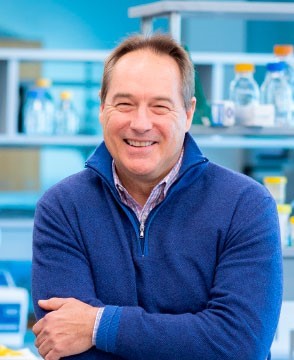
Paul D. Robbins
Robbins helped establish senolytics as a major longevity research path by identifying compounds that clear senescent cells and showing gains in physical function and lifespan.
Profile
Professor at the University of Minnesota and associate director of its aging institute whose laboratory develops senotherapeutics and other approaches targeting hallmarks of aging.
Role
scientisthigh confidence
Robbins authored peer-reviewed aging and senotherapy papers, including studies testing senolytics and senomorphic interventions to reduce cellular senescence. His laboratory's stated route to healthier aging is developing therapies against aging hallmarks.
Dimension breakdown
This score rates longevity commitment only. The role tags above — scientist, investor, and the rest — say what this person is; we don't score those separately.
Future vision
5.0/ 10
Robbins presents a concrete and scientifically grounded strategy for extending healthspan through senotherapeutics targeting multiple hallmarks of aging. His influential, sustained research program supports the durability of this direction, but the evidence contains no explicit destination vision, human-lifespan objective, development timeline, or discussion of translational risks.
medium confidence
Scientific impact
9.5/ 10
Robbins demonstrates field-defining scientific influence, particularly in cellular senescence and senolytics. His exceptional citation profile is reinforced by several foundational geroscience papers with more than 1,000 citations each, showing influence well beyond publication volume.
high confidence
Capital deployed
N/A
The evidence establishes Robbins's substantial scientific impact but identifies no investments, donations, or other deployment of personal or controlled capital. Scientific achievements alone do not make the capital_deployed dimension applicable.
No public capital deployment activity is evidenced for this scientist.
high confidence
Strategic taste
7.0/ 10
Robbins’s publication record shows a coherent translational bet on cellular senescence: defining the mechanism, identifying senolytic compounds, and demonstrating healthspan and lifespan effects. The highly cited 2015–2018 work suggests that this research direction helped establish senotherapeutics as a consequential longevity pathway. However, the evidence does not establish his individual decision-making role, the contemporaneous contrarian nature of the bet, or a clear counterfactual showing that the path depended on him.
medium confidence
Field creation
1.0/ 10
Field creation is applicable, but the supplied evidence establishes scientific collaboration and protocol-relevant research rather than creation of organizations, programs, categories, communities, protocols, or funding paths. Robbins is affiliated with an aging institute, but no evidence shows that he founded it or created a field-building structure.
medium confidence
Bravery and conviction
1.0/ 10
The dimension applies, but the supplied evidence documents scientific productivity and mainstream institutional research rather than public risk-taking or conviction. No qualifying bravery exhibit, career sacrifice, contrarian stance, persistence under serious criticism, consequential personal bet, or self-experimentation is shown.
high confidence
Multiplier effect
7.0/ 10
Robbins demonstrates substantial second-order scientific leverage: his highly cited senescence and senolytic research has influenced a large body of follow-on work, while extensive multi-institutional collaborations and participation in a regional geroscience consortium indicate field-building reach beyond his laboratory. Evidence for attracting capital, founding organizations, shaping policy, or generating companies is absent, limiting a higher score.
medium confidence
Vision
Destination
No canonical quotes yet.
Path
Advances in single-cell, spatial, proteomic and computational methods enable rigorous senotype characterization, improving consistency and accelerating development of targeted senotherapeutics.
The Robbins laboratory is focused on developing approaches to extend healthspan by targeting specific hallmarks of aging including genomic instability, cellular senescence, inflammation, stem cell dysfunction and mitochondrial dysfunction.
Strategy
Robbins develops senotherapeutics and other interventions targeting hallmarks of aging [S1]. His work is positioned within translational geroscience and aims to promote healthier aging [S1]. No investments, donations, founded organizations, or other strategic bets were identified [S1]. The available evidence does not support conclusions about preferred stage, geography, risk appetite, time horizon, or collaborators [S1].
UnknownUnknownSenotherapeuticsHallmarks Of AgingTranslational GeroscienceHealthier Aging
Portfolio
Investments
No public rows yet.
Donations
No public rows yet.
Organizations founded
No public rows yet.
Scientific output
h-index125
Citations-
Papers24
Trials0
Belief evolution
Criticisms